Main Text

It is always a comfort to know that the author of a favourite story was somebody that we feel could have been our friend. In this short passage, Scottish folklorist Andrew Lang gives us his appreciation of the character of the man who created not only Blue Beard but Tom Thumb, Cinderella, and Puss in Boots.

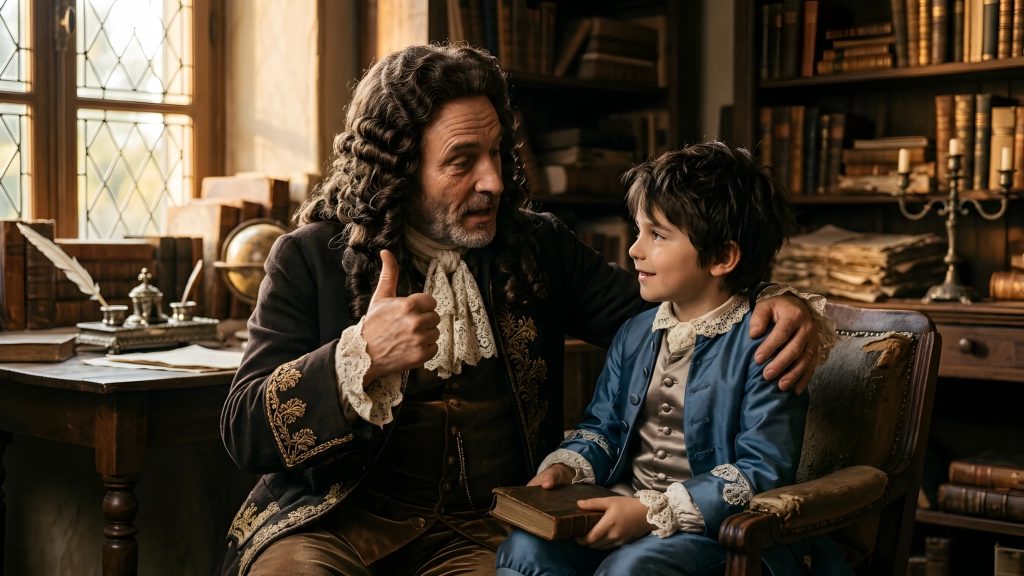
THOUGH a man of unimpeached respectability of conduct, Charles Perrault was a born Irregular.⁠ He was a truant from school, a deserter of the Bar, an architect without professional training, a man of letters by inclination, a rebel against the tyranny of the classics,⁠ and immortal by a kind of accident. He did many things well, above all the things that he had not been taught to do, and he did best of all the thing which nobody expected him to have done. A vivid, genial and indomitable character and humour made him one of the best-liked men of his age, and better remembered than people with far higher contemporary reputation than his own.⁠ [...]

Charles Perrault was a good man, a good father,⁠ a good Christian, and a good fellow. He was astonishingly clever and versatile in little things, honest, courteous, and witty, and an undaunted amateur. The little thing in which he excelled most was telling fairy tales. Every generation listens in its turn to this old family friend of all the world. No nation owes him so much as we of England, who, south of the Scottish, and east of the Welsh marches, have scarce any popular tales of our own save Jack the Giant Killer, and who have given the full fairy citizenship to Perrault’s Petit Poucet and La Barbe Bleue.


Footnotes

Footnote

Charles Perrault

A French author, academician, and high-ranking civil servant under King Louis XIV, Perrault laid the foundations for the modern fairy tale genre. His 1697 collection, Tales of Mother Goose, popularised timeless folklore including Cinderella, Little Red Riding Hood, Sleeping Beauty, and Puss in Boots, embedding moral lessons within fantastical narratives.

Footnote

The tyranny of the Classics

In 1674, Charles’s friend Philippe Quinault collaborated with Jean-Baptiste Lully on Alceste, a groundbreaking French opera. Perrault compared it favourably with the works of Euripides, and did it in print, sparking an outburst of academic outrage dubbed ‘the Quarrel of the Ancients and the Moderns’. Throughout his life, Perrault maintained that the literature of Louis XIV’s France was a brighter light than the literature of the Classical world.

Footnote

Reputation

Perrault was the first Secretary to the the Academy of Inscriptions and Belles-Lettres, founded in 1663, and for some years enjoyed the patronage of Jean Baptiste Colbert, Louis XIV’s finance minister. In 1682, when Perrault was 56, Colbert dismissed him in favour of his own son; and after Colbert died a year later, the new finance minister, François-Michel le Tellier, Marquis de Louvois, cleaned house, revoking Perrault’s pension. As Lang says, these great men of French politics and their deeds have been all but eclipsed by the tales of Charles Perrault.

Footnote

A good father

Charles married Marie Guichon in 1672, when he was 44 and she was 19. Six years later, she died. Their children included Charles, Charles Samuel, and Pierre, known as Pierre D’armancourt; Charles put Pierre’s name to some of his earliest tales, perhaps to confuse critics who could not tolerate his challenge to the Classics.

Author Details

Andrew Lang

Get in touch with me through my profile on
Buy Me a Coffee