
Main Text
A wealthy gentleman has approached a lady of the town and asked for one of her two daughters — he does not mind which — in marriage. The prospect does not delight either of them, for the gentleman is rumoured to have been married before, and wears an ugly blue beard. Nevertheless, one is chosen, and the magnificence of his château is some compensation for that horrible beard.
At the end of a month, Blue Beard told his wife that he was obliged to take a journey, which would keep him away from home for six weeks at least, as he had business of great importance to attend to. He begged her to amuse herself as well as she could during his absence, to invite her best friends, and, if she liked, take them into the country, and wherever she was, to have the best of everything for the table. Here,
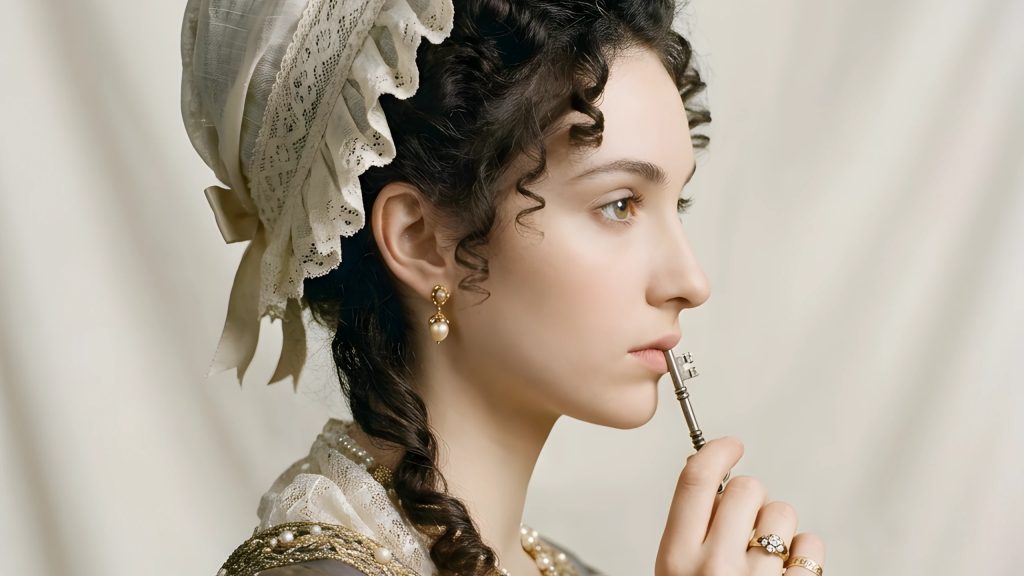
said he to her, are the keys of my two large store-rooms; these are those of the chests in which the gold and silver plate, not in general use, is kept; these are the keys of the strong boxes in which I keep my money; these open the caskets that contain my jewels, and this is the master-key of all the rooms. As for this little key, it is that of the closet at the end of the long gallery on the ground floor. Open everything, and go everywhere except into that little closet, which I forbid you to enter, and I forbid you so strictly, that if you should venture to open the door, there is nothing that you may not have to dread from my anger!
She promised to obey his orders to the letter, and, after having embraced her, he got into his coach and set out on his journey.
The friends and neighbours of the young bride did not wait for her invitation, so eager were they to see all the rich treasures in the house, and not having ventured to visit her while her husband was at home, so frightened were they at his blue beard. They were soon to be seen running through all the rooms, and into the closets and wardrobes, each one more beautiful and splendid than the last. Then they went upstairs to the store-rooms; there they could not sufficiently express their admiration at the number and beauty of the hangings, the beds, the sofas, the cabinets, the elegant little stands, the tables, the mirrors in which they could see themselves from head to foot, framed some with glass, some with silver, some with gilt metal, all of a costliness beyond what had ever before been seen. They never ceased enlarging upon, and envying, the good fortune of their friend, who, meanwhile, took no pleasure in the sight of all these treasures, so great was her longing to go and open the door of the closet on the ground floor. Her curiosity at last reached such a pitch that, without stopping to consider how rude it was to leave her guests, she ran down a little back staircase leading to the closet, and in such haste that she nearly broke her neck two or three times before she reached the bottom. At the door of the closet she paused for a moment, calling to mind her husband’s prohibition, and reflecting that some trouble might fall upon her for her disobedience; but the temptation was so strong that she could not resist it. So she took the little key, and with a trembling hand opened the door of the closet.
At first she could distinguish nothing, for the windows were closed; in a few minutes, however, she began to see that the floor was covered with blood, in which was reflected the bodies of several dead women hanging on the walls. These were all the wives of Blue Beard, who had killed them one after another. She was ready to die with fright, and the key, which she had taken out of the lock, fell from her hand.